
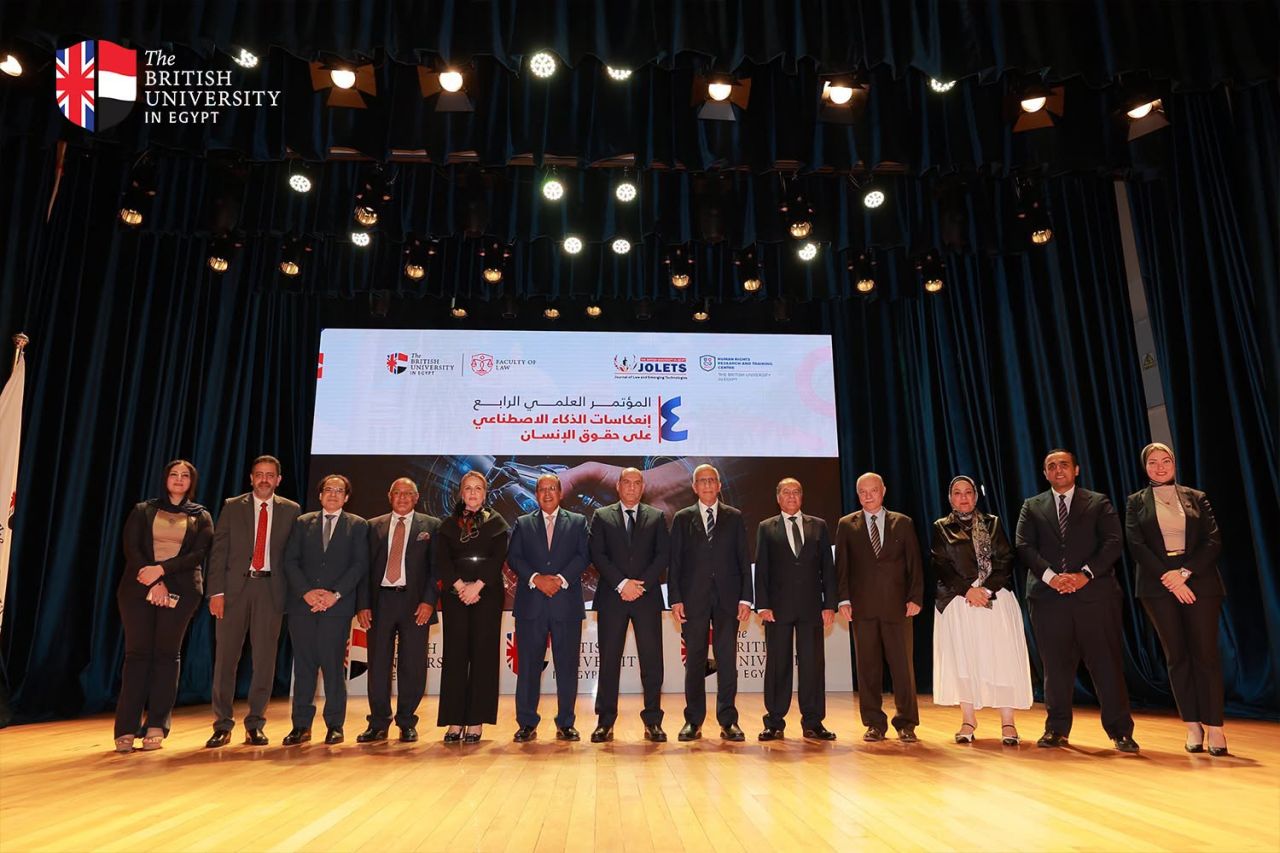
Dr. Mohamed El-Guindy, Advisor to the Public Prosecution and Senior Cybercrime and Cybersecurity Consultant at the United Nations Office on Drugs and Crime (UNODC)and The President of ISSA Egypt Chapter, participated in the Fourth Scientific Conference of The British University in Egypt – Faculty of Law, entitled “The Implications of Artificial Intelligence on Human Rights.”
The conference brought together policymakers, judges, academics, legal professionals, and technology specialists to examine the growing impact of Artificial Intelligence on justice, labour markets, human rights, and public institutions.
Dr. El-Guindy’s contribution focused on the international and law-enforcement dimension of AI governance, with particular attention to the challenges that arise when technology platforms, data, AI systems, and digital evidence operate across multiple jurisdictions.
Among Dr. El-Guindy’s key reflections was that the discussion around Artificial Intelligence must now move beyond AI Governance alone. The real institutional challenge is increasingly concerned with AI Accountability and Enforcement.
This includes the ability of institutions to understand the technology, investigate its misuse, access the necessary digital evidence, and ensure that responsibility remains clear when automated systems influence decisions affecting individuals.
The conference discussions also addressed the future of work, the administration of justice, transparency, accountability, and human-centred AI, reinforcing the importance of ensuring that technological development remains aligned with fundamental rights and institutional accountability.
A central principle highlighted through these discussions is that technology should enhance human capability and institutional effectiveness, not weaken accountability or fundamental rights.
Appreciation is extended to The British University in Egypt – Faculty of Law, its leadership, and all colleagues and experts who contributed to this valuable interdisciplinary discussion.