
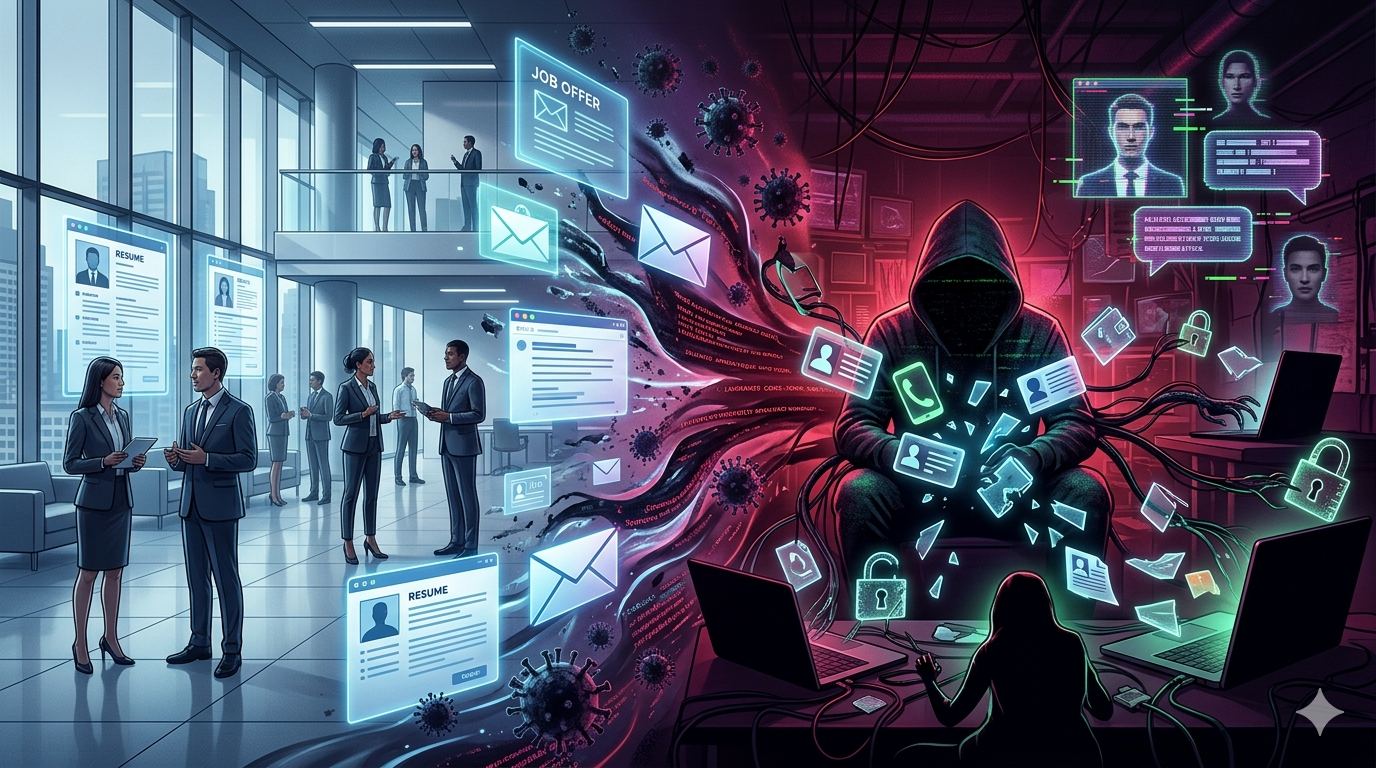
Recent cybersecurity reports have highlighted a concerning trend in which personal information obtained through alleged data leaks may be leveraged to support highly targeted social engineering and malware distribution campaigns.
Among the incidents referenced in recent reporting are claims involving an alleged data leak associated with the Saudi digital media platform Thmanyah, reports concerning the exposure of approximately 180,000 blood donor records linked to the Wateen application, and the emergence of fraudulent recruitment campaigns distributing malware known as JobStealer targeting both Windows and macOS users.
While these incidents may appear unrelated, cybersecurity professionals note that they reflect a broader pattern in which threat actors combine publicly available information, leaked personal data, and social engineering techniques to increase the effectiveness of cyberattacks.
Modern attackers increasingly rely on personal information such as names, email addresses, telephone numbers, professional backgrounds, and job-search activity to create highly convincing communications. By leveraging real information, cybercriminals can impersonate recruiters, employers, or human resources departments and distribute malicious files or applications disguised as legitimate interview materials or employment opportunities.
Researchers warn that malware delivered through fraudulent recruitment campaigns may be capable of stealing credentials, browser session tokens, sensitive documents, cryptocurrency wallet information, and other valuable data stored on compromised devices.
The growing use of artificial intelligence to generate realistic emails, messages, and recruitment communications has further increased the sophistication and credibility of such attacks, making them more difficult for potential victims to identify.
Cybersecurity experts recommend that individuals seeking employment and professionals engaging with recruiters adopt precautionary measures, including:
- Verifying the legitimacy of recruiters, organizations, and job opportunities
- Avoiding the installation of applications or software obtained from unverified sources
- Carefully reviewing email addresses, website domains, and communication channels
- Exercising caution when asked to continue discussions through messaging platforms without verification
- Enabling multi-factor authentication (MFA) on accounts and services
- Remaining alert to unsolicited employment offers that create urgency or request sensitive information
Security professionals emphasize that the long-term impact of a data breach is often determined not only by the exposure of information, but by how that information is subsequently exploited to facilitate fraud, phishing, credential theft, and malware deployment.
As cybercriminals continue to combine leaked personal information with increasingly sophisticated social engineering techniques, organizations and individuals alike are encouraged to maintain strong cybersecurity awareness and verification practices.
Disclaimer: References to alleged data leaks are based on publicly reported claims and available reporting at the time of publication. Readers should rely on official statements from affected organizations regarding the confirmation, scope, and impact of any reported incidents.