
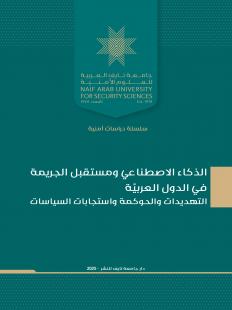
Dr. Mohamed El Guindy, Advisor to the Public Prosecution and Senior Cybercrime and Cybersecurity Consultant at the United Nations Office on Drugs and Crime, has co-authored a new research study titled “Future of Crime in Arab States: Threats, Governance and Policy Responses,” published by Naif Arab University for Security Sciences.
Co-authored with Dr. Betania Allo and Dr. Taqwa Alhaj, the publication is available in both English and Arabic and provides a comprehensive assessment of how artificial intelligence is reshaping crime, security, and governance across the Arab region.
The study examines AI’s dual impact on public safety. While emerging AI technologies are enabling increasingly sophisticated cybercrime, financial fraud, deepfakes, voice cloning, and other forms of technology-enabled crime, they also present significant opportunities to strengthen law enforcement through intelligent analytics, predictive policing, digital evidence examination, and crime prevention.
A major contribution of the research is the development of an Arabic audio deepfake detection model based on RawNet2. Trained on more than 44,000 audio samples, the model achieved a reported 99.25% accuracy, addressing a critical gap in Arabic-language AI security technologies and supporting regional efforts to combat AI-generated disinformation and digital deception.
Recognizing that addressing AI-enabled crime requires coordinated action beyond technical innovation, the study proposes a comprehensive four-dimensional roadmap to strengthen resilience across the Arab States through:
- Legislative and regulatory reform.
- Enhanced institutional capabilities and regional cooperation.
- Investment in defensive AI and Arabic-language detection technologies.
- Digital awareness and societal resilience.
Designed for policymakers, legislators, prosecutors, law enforcement agencies, cybersecurity professionals, researchers, and academic institutions, the study offers practical, evidence-based recommendations to support balanced AI governance while enhancing regional preparedness against emerging security threats.
The publication reflects the importance of collaboration between regional and international experts in addressing one of today’s fastest-evolving security challenges. By combining legal, policy, and technical perspectives, it contributes to the development of effective strategies for preventing and responding to AI-enabled crime while promoting the responsible use of artificial intelligence across the Arab States.
The publication of this research represents an important milestone in advancing regional dialogue on AI, cybersecurity, and criminal justice, and provides a valuable reference for governments and institutions working to strengthen security, resilience, and evidence-based policymaking in the digital age.
📥 Read the full study (available in English and Arabic):
https://lnkd.in/dmPTJ2cz